# Harlock
[](https://hex.pm/packages/harlock)
[](https://hexdocs.pm/harlock)
[](https://github.com/thatsme/harlock/actions/workflows/ci.yml)
[](LICENSE)
A pure-Elixir TUI framework for Unix terminals. TEA-style
model / update / view loop on top of OTP, with first-class focus
traversal, layout constraints, ANSI cell-diff rendering, and a small
termios NIF for direct `/dev/tty` control.
```elixir
defmodule Counter do
use Harlock.App # imports the view DSL (box/1, text/2, vbox/1, …)
def init(_), do: %{n: 0}
def update({:key, {:char, ?+}, []}, m), do: %{m | n: m.n + 1}
def update({:key, {:char, ?-}, []}, m), do: %{m | n: max(0, m.n - 1)}
def update({:key, {:char, ?q}, []}, _), do: :quit
def update(_, m), do: m
def view(m) do
box(
title: "Counter",
border: :rounded,
child: text("count: #{m.n}")
)
end
end
Harlock.run(Counter)
```
A more realistic app wires focus traversal, a selectable table, a
scrollable viewport, and a side-effect via `Cmd` — all together. Tab
moves focus between the two boxes; the focused widget owns its keys.
Full source: [`examples/overview.exs`](examples/overview.exs).
```elixir
defmodule Overview do
use Harlock.App
alias Harlock.{Cmd, Focus}
def init(_) do
%{
tasks: [
%{id: 1, name: "compile", state: "done"},
%{id: 2, name: "test", state: "running"},
%{id: 3, name: "dialyzer", state: "queued"},
%{id: 4, name: "credo", state: "queued"},
%{id: 5, name: "publish", state: "blocked"}
],
selected: 1,
log: for(i <- 1..40, do: "[#{i}] event line #{i}"),
log_offset: 0
}
end
def update({:key, {:char, ?q}, []}, _), do: :quit
def update({:key, {:char, ?r}, []}, m) do
cmd =
Cmd.from(fn -> Enum.map(1..3, &"[refresh] new line #{&1}") end)
|> Cmd.map(fn lines -> {:refreshed, lines} end)
{m, cmd}
end
def update({:refreshed, lines}, m), do: %{m | log: lines ++ m.log}
# The runtime auto-routes scroll keys to the focused viewport and
# delivers this message; the app just writes where the offset lives.
def update({:harlock_scroll, :log, new_offset}, m), do: %{m | log_offset: new_offset}
def update({:key, _, _} = ev, m) do
case Focus.current() do
:tasks -> update_tasks(ev, m)
_ -> m
end
end
def update(_, m), do: m
defp update_tasks({:key, :up, _}, m), do: %{m | selected: max(1, m.selected - 1)}
defp update_tasks({:key, :down, _}, m),
do: %{m | selected: min(length(m.tasks), m.selected + 1)}
defp update_tasks(_, m), do: m
def view(m) do
here = Focus.current()
vbox(
constraints: [fill: 1, length: 1],
children: [
hbox(
constraints: [percentage: 40, fill: 1],
children: [
box(
title: "Tasks",
border: :rounded,
border_style: border_style(here == :tasks),
focusable: :tasks,
child:
table(
columns: [
column(title: "#", width: {:length, 3}, render: &Integer.to_string(&1.id)),
column(title: "name", width: {:fill, 1}, render: & &1.name),
column(title: "state", width: {:length, 8}, render: & &1.state)
],
rows: m.tasks,
row_id: & &1.id,
selection: {:single, m.selected}
)
),
box(
title: "Log",
border: :rounded,
border_style: border_style(here == :log),
child:
viewport(
focusable: :log,
offset: m.log_offset,
content_height: length(m.log),
child:
vbox(
constraints: List.duplicate({:length, 1}, length(m.log)),
children: Enum.map(m.log, &text/1)
)
)
)
]
),
text("Tab focus arrows/PgUp/PgDn scroll r refresh q quit", style: [dim: true])
]
)
end
defp border_style(true), do: [fg: :cyan, bold: true]
defp border_style(false), do: [dim: true]
end
Harlock.run(Overview)
```
## Installation
```elixir
def deps do
[{:harlock, "~> 0.4"}]
end
```
Harlock builds a small C NIF (`c_src/termios.c`, ~250 LOC of POSIX) for
termios access — `elixir_make` handles this automatically. Requires a
C compiler and `make` available at install time. macOS, Linux, and
\*BSD are supported; Windows native is not (WSL works).
## Why Harlock
If you've written a Phoenix LiveView app you already know how to use
Harlock — `init / update / view`, message-passing for events,
side-effects as `Cmd` values. The runtime is a single OTP supervision
tree: terminal owner → IO → cmd executor → TEA loop, with terminal
restoration guaranteed on any crash path via the supervisor's
`rest_for_one` strategy.
Compared to alternatives:
- **[Owl](https://hex.pm/packages/owl)** is a styled-output library
("println but pretty"). Harlock is a full interactive runtime —
focus, layout, dirty-flag rendering, async cmds, resize handling.
- **[Ratatouille](https://hex.pm/packages/ratatouille)** wraps termbox
via a C port. Solid, but the C dep is bigger and the runtime model
is its own thing. Harlock is pure-Erlang for rendering with a small
in-process NIF only for termios — closer to "Elixir all the way
down" if that matters to you.
- **ratatui-via-port** approaches (Rust binary speaking a wire
protocol to BEAM) ship as two artifacts: your Elixir release plus a
separately-compiled Rust binary that has to be on `PATH` at runtime.
Harlock ships as one mix release — no extra binary, no version-skew
between BEAM and renderer. The element tree is also ordinary Elixir
data, which makes testing and composition easier than a wire-protocol
boundary.
## Status
Harlock is `v0.4`. The API is intentionally narrow and stable for the
primitives it ships; widgets and ergonomics are still landing.
Anything `@moduledoc false` is internal and free to change.
| Area | Status |
|---|---|
| TEA runtime (`init` / `update` / `view` / `subs`) | ✓ |
| OTP supervision + terminal restoration | ✓ |
| Cmd executor (`Cmd.from`, `Cmd.batch`, `Cmd.map`) | ✓ |
| Layout constraints (`:length`, `:percentage`, `:fill`, `:min`, `:max`) | ✓ |
| Focus traversal + focus_trap overlays | ✓ |
| Focus-aware widget key routing (`viewport` / `tabs` / `text_input`) | ✓ (v0.4) |
| Wide-grapheme width (CJK, emoji, ZWJ, flags) | ✓ |
| Theme tokens (`:header`, `:focus`, `:selection`, `:border`, `:primary`, `:accent`, `:muted`, `:error`) | ✓ (full set in v0.4) |
| Built-in themes (`:default` / `:dark` / `:high_contrast`) | ✓ (v0.4) |
| Caps-aware color downgrade (truecolor → 256 → 16 → mono) | ✓ (v0.4) |
| Table style cascade (`:header_style` / `:row_style` / `:alt_row_style` / `:selected_style` / `:focus_style`) | ✓ (v0.4) |
| `:default` theme byte-identical to v0.3 (golden-frame pin) | ✓ (v0.4) |
| SIGWINCH resize via `ioctl(TIOCGWINSZ)` NIF | ✓ |
| `text` / `vbox` / `hbox` / `box` / `spacer` / `overlay` / `table` / `list` / `text_input` | ✓ |
| `progress` / `spinner` / `statusbar` / `keybar` / `tabs` | ✓ |
| `viewport` (render-then-clip + scroll-into-view + cursor remap) | ✓ |
| `:telemetry` events (frame render, input dispatch, cmd, reader) | ✓ |
| Modified arrows / Home / End / F-keys (parser) | ✓ |
| Mouse events (SGR parser) | ✓ (parser only — runtime enabling deferred) |
| Kitty keyboard protocol (parser) | ✓ (parser only — runtime push deferred) |
| `tree` / `menu` / `select` widgets | v0.4.1 |
| Multi-line `text_area` | v0.4.1 |
| Richer `Sub` kinds (`pubsub` / `file` / `signal` / `port`) | v0.4.1 |
| `box(focus_proxy: id)` (visual focus mirroring) | v0.4.1 |
See [`ROADMAP.md`](ROADMAP.md) for the full plan through v1.0.
## Examples
```sh
./scripts/run.sh counter # simplest possible app — count up/down
./scripts/run.sh sysmon # live BEAM process monitor
./scripts/run.sh contacts # contact manager: search, list, modal forms, async save
./scripts/run.sh showcase # tabs, viewport, widgets, modified keys
```
The `scripts/run.sh` wrapper is in the GitHub repo — clone the repo to
run the examples. The hex package itself is the library; apps depend
on `:harlock` and build their own runtime entry point (see the Counter
snippet above).
`contacts` exercises most of the core primitives: tab focus traversal,
text_input fields, an overlay with focus_trap, async save via
`Cmd.from`, custom theme, status bar with current-focus indicator.
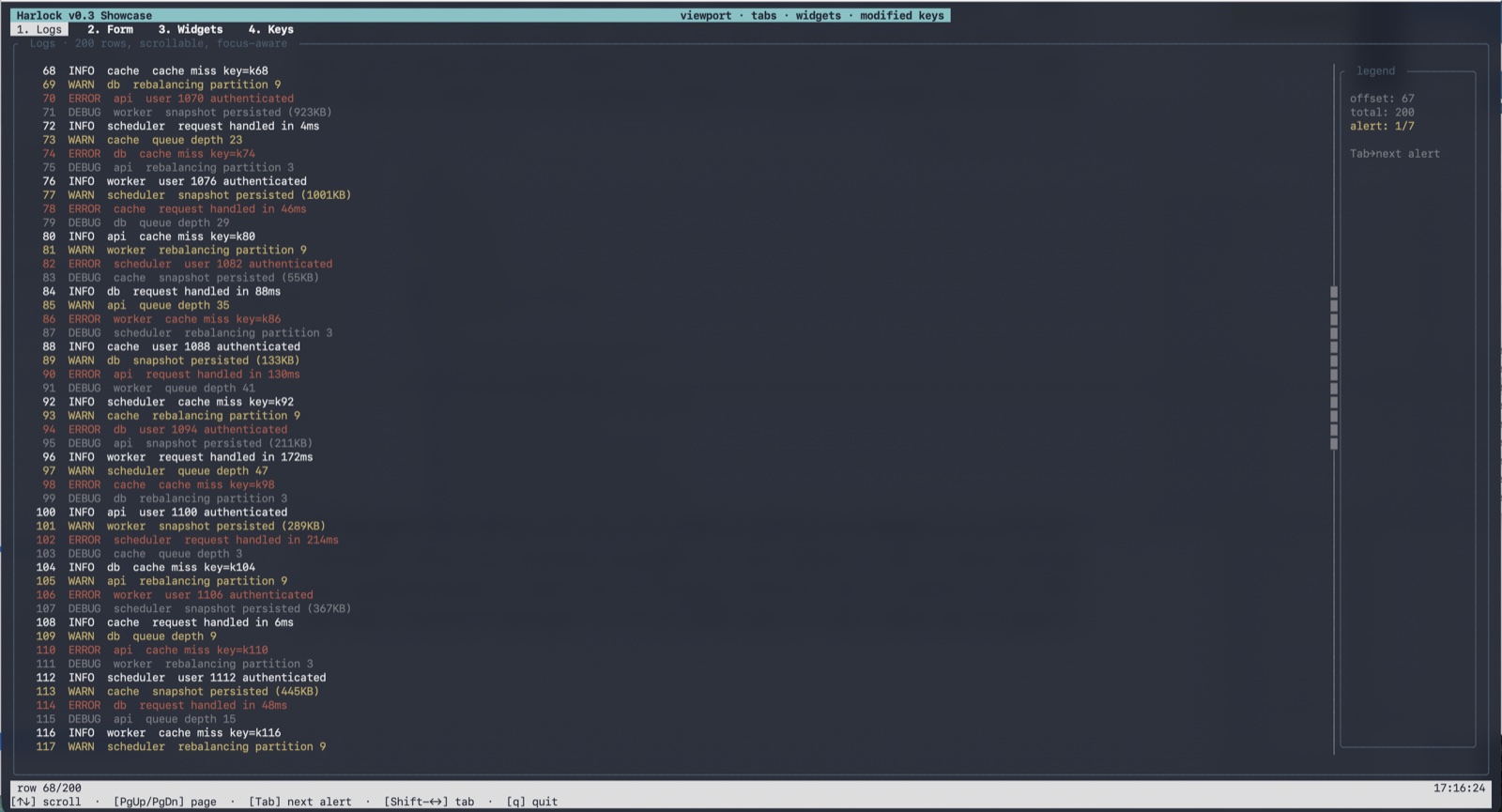
`showcase` is a four-tab tour of everything that landed in v0.3 — a
200-row scrollable log viewer with `viewport` + scrollbar, a long form
that uses scroll-into-view to keep the focused field visible, a
widget gallery with animated progress/spinner/statusbar/keybar, and a
key-event inspector you can use to try out modified arrows
(Ctrl-Up, Shift-Right, etc.).
## Testing your app
`Harlock.Test` boots an app under a headless backend — no `/dev/tty`
required — and exposes synchronous helpers:
```elixir
test "Tab cycles focus through the form" do
h = Harlock.Test.start_app(MyApp, init_arg)
Harlock.Test.send_key(h, :tab)
assert Harlock.Test.focused(h) == :email
Harlock.Test.send_key(h, :tab)
assert Harlock.Test.focused(h) == :submit
Harlock.Test.stop(h)
end
```
Same code path as the real runtime — only the bytes-in / bytes-out
boundary is mocked.
## Smoke tests
A handful of scripts in `priv/*_smoke.exs` exercise the real
runtime + termios NIF via `script(1)`:
```sh
./scripts/smoke.sh
```
Picks the right flag syntax for BSD vs util-linux `script` automatically.
## Contributing
Issues and PRs welcome at <https://github.com/thatsme/harlock>. The
codebase is small enough (~3k LOC of Elixir + ~250 LOC of C) to read
in an afternoon. Start with `lib/harlock/app/runtime.ex` — everything
else is reachable from there.
## License
MIT. See [`LICENSE`](LICENSE).